Range-wide Gray Whale Science Symposium
Coordinated by the Marine Mammal Commission and hosted by the Marine Mammal Institute at Oregon State University
Hatfield Marine Science Center, Newport, Oregon
September 9-10, 2026
Overview
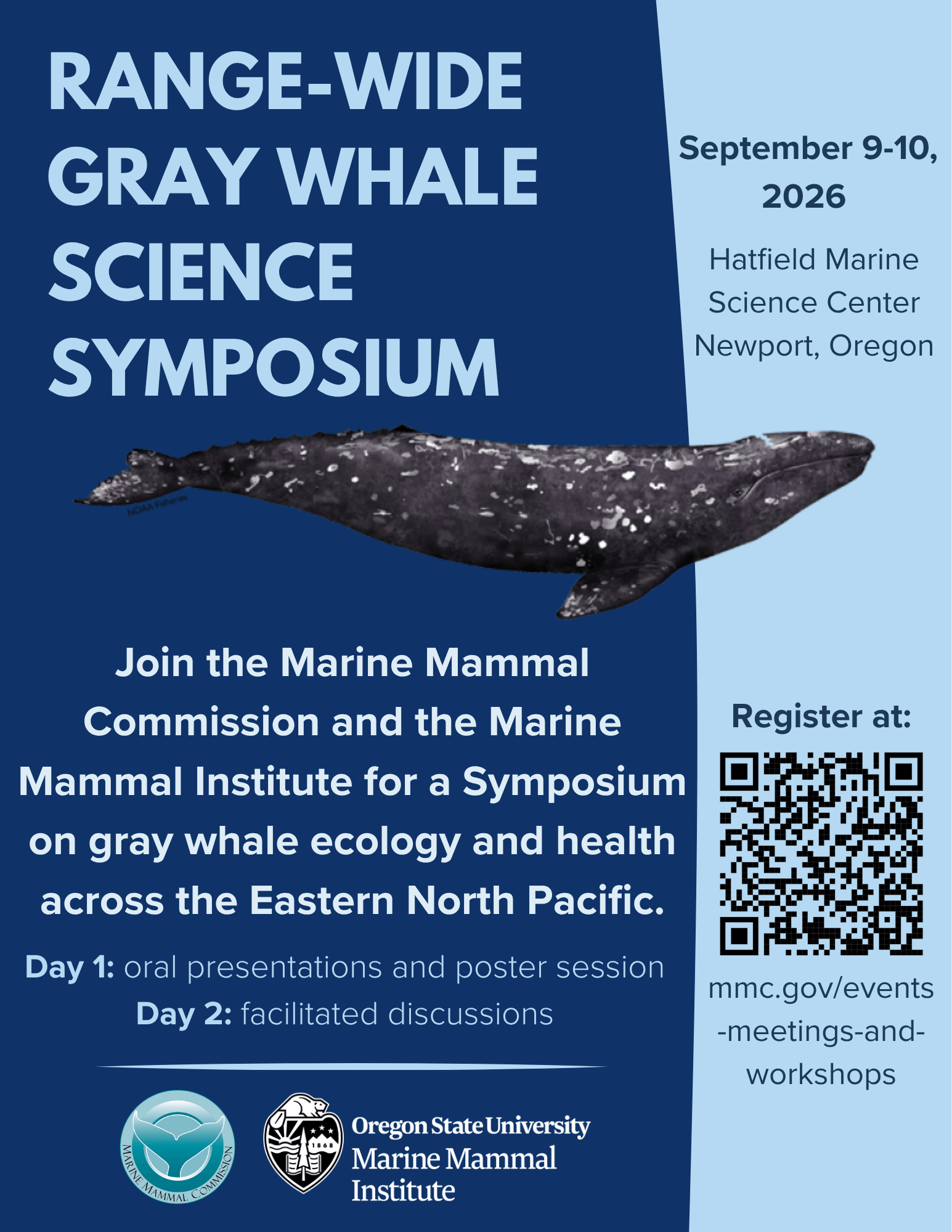
A public range-wide Gray Whale Science Symposium took place on September 9–10, 2026, coordinated by the Marine Mammal Commission and hosted by the Marine Mammal Institute at Oregon State University in Newport, Oregon. This two-day scientific meeting focused on gray whale ecology and health across the Eastern North Pacific (ENP) and Arctic and synthesized current research and observations to improve understanding of recent trends in health, feeding behavior, distribution, and population dynamics, and to identify priorities for future research, monitoring, and coordination.
Goals
The Symposium goals were to:
1) Review gray whale ecology and health status in the context of recent marine ecosystem variability in the ENP and Arctic;
2) Outline future priorities for gray whale ecology research and health surveillance and monitoring to help fill identified data gaps and address management objectives;
3) Enhance communication amongst scientists from Mexico, USA and Canada monitoring and conducting research on gray whale population status, health and ecology; and
4) Produce a symposium proceedings summarizing presentations and recommendations for future directions.
Meeting Materials
Click here for a PDF copy of the Symposium program
Click here for a PDF copy of the Symposium proceedings
Meeting Recordings
Visit the Commission’s YouTube Channel to watch every session of Day 1 from the symposium.
Day 1: Tuesday September 9
Meeting Opening
- Welcome and Introduction to the Meeting
Lisa Ballance, Oregon State University (OSU), and Frances Gulland, Marine Mammal Commission (MMC)
Session 1: Eastern and Western North Pacific Gray Whale Population Overview
Moderator: Aimée Lang, NOAA Fisheries, Southwest Fisheries Science Center (SWFSC)
- The ebb and flow of gray whales in the eastern North Pacific: from whaling to warming and a bumpy ride in between
Dave Weller, NOAA Fisheries, SWFSC, and Josh Stewart, Marine Mammal Institute, OSU - Monitoring gray whale status in the wintering lagoons of Baja California Sur, Mexico
Steven Swartz, Gray Whale Research in Mexico and The Ocean Foundation, and Jorge Urbán Ramírez, Gray Whale Research in Mexico and Marine Mammal Research Program, Universidad Autónoma de Baja California Sur - Western North Pacific gray whales: status and trends
Alexander Burdin, Kamchatka Branch of Pacific Geographical Institute, Russian Academy of Sciences - Atlantic gray whales: Then and now
Randy Reeves, MMC - Discussion
Session 2: Changing Ecology of Eastern North Pacific Gray Whales and the Pacific Coast Feeding Group
Moderator: Dave Weller, NOAA Fisheries, SWFSC
- Panel Discussion: Eastern North Pacific gray whale regional ecology
- Gulf of Alaska:
- KC Bierlich, Marine Mammal Institute, OSU
- Lauren Wild, University of Alaska Southeast
- Gulf of Alaska:
-
-
- Andy Szabo, Alaska Whale Foundation
- Offshore Vancouver Island:
- Erin Foster, Fisheries and Oceans Canada
- Offshore Washington:
- John Calambokidis, Cascadia Research Collective
- Southern California Bight:
- Alisa Schulman-Janiger, American Cetacean Society-Los Angeles Chapter and the Natural History Museum of Los Angeles County
- Baja California Peninsula, Mexico:
- Steven Swartz, Gray Whale Research in Mexico and The Ocean Foundation
-
- Connectivity, and lack of connectivity, of PCFG and other ENP gray whales
Jonathon Scordino, Makah Fisheries Management, Makah Tribe - Gray whale adaptation and resilience in a changing ocean with insights from the Pacific Coast Feeding Group
Leigh Torres, Marine Mammal Institute, OSU
Session 3: Ecosystem Changes Impacting Gray Whales
Moderator: Jason Baker, MMC
- North Pacific marine ecosystems: Eastern North Pacific, California Current, and Gulf of Alaska seasonal patterns and marine heat events
Nate Mantua, NOAA Fisheries, SWFSC - Pacific Arctic ecosystems: North Bering and Chukchi sea ice loss and ecosystem transformation
Kate Stafford, Marine Mammal Institute, OSU - Time series trends in benthic prey populations in the northern Bering and Chukchi Seas
Jackie Grebmeier, Chesapeake Biological Laboratory, University of Maryland Center for Environmental Science - Exposure risks and impacts of harmful algal bloom (HAB) toxins in marine mammals
Kathi Lefebvre, NOAA Fisheries, Northwest Fisheries Science Center, Wildlife Algal-toxins Research and Research and Response Network (WARRN-West) - Discussion
Session 4: Overview of Lethal and Sublethal Threats to Health and Survival
Moderator: Lori Schwacke, MMC
- Strandings: UME and post-UME update, including cause of death findings
Deb Fauquier, NOAA Fisheries, Office of Protected Resources - Range-wide assessment of gray whale nutritional status via drone-based photogrammetry
KC Bierlich, Marine Mammal Institute, OSU - Insights from the Pacific Northwest on alternate feeding areas and nutritional status
John Calambokidis, Cascadia Research Collective - Biomarkers of gray whale physiological status: assessing stress, reproduction, and metabolic state via hormones and novel biomarkers
Kathleen Hunt, Marine Mammal Institute, OSU
- Gray whale ecological responses to environmental change during a prolonged mortality event revealed by baleen stable isotopes: What can stable isotopes tell us, and what are their limitations?
Geraldine Busquets-Vass, Centro de Investigación Científica y de Educación Superior de Ensenada, Unidad Académica La Paz - Discussion
Day 1 Wrap Up and Poster Session
Note: The Day 1 evening poster session and Day 2 discussions are in-person only and were not recorded.
Day 2: Panel Discussions and Synthesis
Panel discussions focused on key themes, knowledge gaps, and future priorities, with the goal of identifying areas for coordination and next steps.
For more information, contact Lauri Leach (lleach@mmc.gov) or Jackie Shaff (jshaff@mmc.gov)