Arctic
The Arctic marine environment is changing rapidly. The most obvious indicator of such change is the dramatic reduction of seasonal sea-ice, but many other aspects of Arctic marine ecosystems are being profoundly altered. The impacts of these changing environmental conditions on marine mammals may be exacerbated by the rapid changes in human activity that they make possible (e.g., expansion of shipping and offshore energy exploration, mining, commercial fishing, coastal development and tourism).
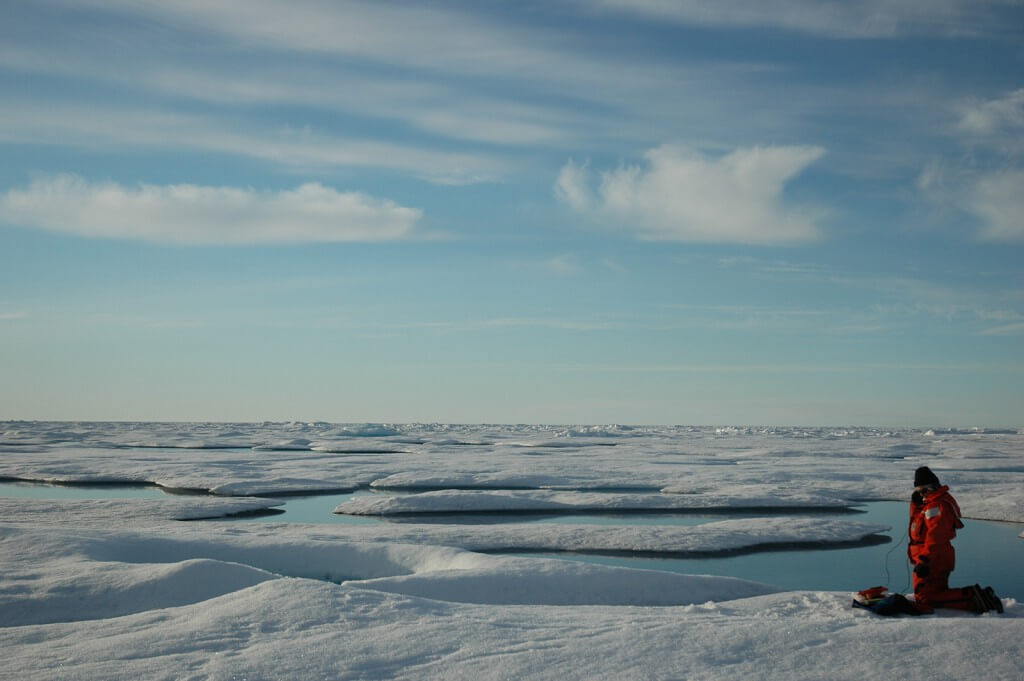
Scientist listening for real-time sounds of marine mammals and other marine fauna in the Arctic Ocean, Canada Basin. (Jeremy Potter, NOAA/OAR/OER)
Marine mammals endemic to the Arctic are uniquely adapted to life in icy waters. These include bowhead whales, polar bears, several species of “ice seals,” beluga whales, and walruses. These and other marine species (e.g., Arctic seabirds) rely on the year round or seasonal presence of sea ice. Other species (e.g., humpback, fin, and gray whales) migrate to the Arctic from more temperate regions to feed during the summer months. These species follow the receding sea ice edge and take advantage of the region’s immense summer biological productivity. As environmental conditions shift, loss of sea-ice is degrading or eliminating important habitat of marine mammals that use sea-ice and snow cover for foraging, resting, molting, reproduction, and refuge from predators. The long-term consequences of these changes for other species, including bowhead and beluga whales and seasonal visitors such as gray whales and humpback whales, are less clear. However, virtually all marine mammals are likely to be affected at least indirectly by the rapid ecosystem-level changes that are underway across the Arctic.
Environmental Changes and Impacts to Marine Mammals
Impacts of Sea Ice Declines
Sea ice is declining rapidly in both quantity and quality, with profound consequences for marine mammals that rely on sea ice platforms for foraging, resting, molting, and refuge from predators. These shifts may result in reduced fitness of individual animals, changes in population abundance, and altered migratory behaviors and distributions.
A frequently cited example of how the decline in sea ice is affecting Arctic marine mammals is the polar bear, which relies on sea ice to hunt seals, although these impacts vary by region and polar bear population. Generally, as the ice extent decreases, polar bears must spend more time and travel greater distances in search of prey, which can result in poor body condition and reduced reproductive success. Polar bears have also responded to declines in sea ice by moving onto land to forage, bringing them closer to human communities and increasing the potential for inter-species conflict. Efforts to mitigate conflict, like North Slope Borough’s Polar Bear Patrol Program or the use of “Bear-dar” in Churchill, Manitoba to alert the community of approaching polar bears, can help to keep both bears and humans safe.
Walruses in the Chukchi Sea have similarly been forced onto land to rest (or haul out) in large numbers as sea ice extent retreats into deep waters beyond shallower walrus foraging areas. The need to rest on land increases the species’ vulnerability to disturbance from predators or human activities. Disturbances can cause walruses to stampede, resulting in mass mortality from crushing, particularly of calves or smaller individuals. When sea ice is unavailable, walruses also travel farther to forage and migrate, which increases their energetic demands. These and anthropogenic disturbance are likely to lead to a decline in the overall abundance and population growth rate of walrus.
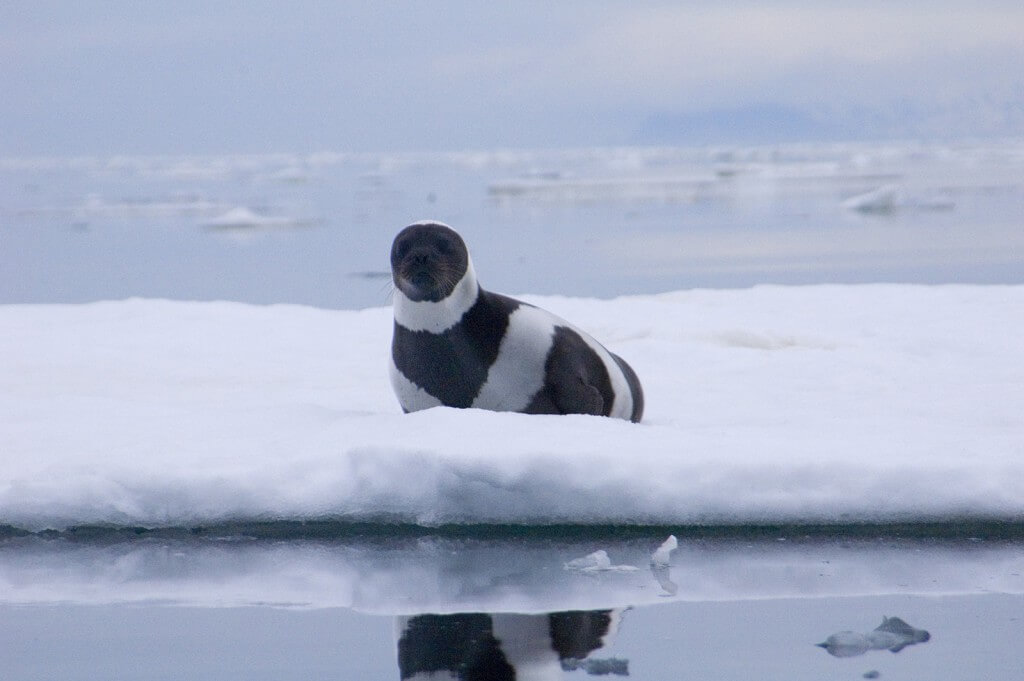
Ribbon seal hauled out on the ice. (Michael Cameron, NMFS)
Ringed seals rely on dense continuous pack ice and snow cover to dig lairs for shelter from weather and predation (especially when pupping). Loss of ice and decreased snow depth in a warming Arctic compromises the structure of lairs and may negatively affect adult body condition and pup survival. Bearded seals prefer to haul out on broken ice pack, and as sea ice extent decreases, they appear to be hauling out more frequently on land. The extent to which ringed and bearded seals are switching from sea ice to land haulouts, or the impact of this or other behavioral adaptations to changing conditions on their reproductive success, are not yet fully known.
Changes to the Food Web: Prey and Pathogens
Many Arctic marine mammals will also be indirectly affected as the food webs on which they depend undergo changes. Restructured food webs, changes in prey populations, the arrival of new marine mammal species (including new predators and competitors), and pathogens from more temperate seas will challenge Arctic species.
Findings suggest that harmful algal blooms (HABs) are expanding north as sea ice extent declines and water temperatures rise. HAB paralytic toxins like saxitoxin and domoic acid have been found in walruses, seals, and Arctic cetacean species. More consistent and widespread monitoring of toxin levels in marine mammals and other marine species may help to alert scientists to potential HAB-related risks to both human and marine mammal health.
Increasing Human Activity in the Arctic
Declines in the seasonal extent of sea ice are creating more opportunities for human activity in the Arctic, with resulting impacts on marine mammals. The disappearance of sea ice from coastlines earlier in the year, coupled with the ice’s retreat farther from shore during the summer (and tendency to remain offshore longer) means there is now a large and increasing annual window of open water. These changes create opportunities for shipping, tourism, commercial fishing, oil and gas exploration and development, and military operations to expand into new areas. These activities create the potential to expose Arctic marine mammals to a variety of new threats, including vessel strikes, pollution, entanglement in fishing nets or lines, and exposure to human-caused sound and other forms of disturbance.
Indigenous communities in the Arctic depend on marine mammals for subsistence and cultural identity. Changing ice and weather conditions are affecting the movements of marine mammals as well as the conditions for subsistence hunting. Extended open water periods, lack of stable sea ice, high winds, stronger currents, and the need to venture farther from shore to hunt marine mammals along the ice edge may present new dangers in pursuing subsistence hunting activities. There are also concerns over the potential danger to or conflict with subsistence hunters from new “industrial” or shipping activities in the Arctic.
The predicted increase in Arctic shipping has prompted the U.S. Coast Guard to seek input on vessel routing measures that would minimize impacts of shipping on marine mammals and Arctic communities. The Commission’s comments on the U.S. Coast Guard’s Alaskan Arctic Coast Port Access Study (Arctic PARS) were based on an analysis of best available scientific data on marine mammal distributions and seasonal movements in the U.S. Chukchi and Beaufort Seas. The Commission worked with biologists at NOAA and Duke University to generate recommended vessel routing through Alaskan Arctic waters and areas to avoid in order to protect marine mammals. The Commission also prepared a fact sheet summarizing its comments on the Arctic PARS.
Commission Activities in the Arctic
The Marine Mammal Commission has long sought to further scientific understanding of the impacts of environmental changes on marine mammals, including Arctic-specific impacts, by working with and bringing together experts to discuss and publish the latest science. The Commission supports baseline research and environmental monitoring in U.S. waters and around the Arctic to document changes to marine ecosystems.
Unique among federal agencies, the Commission is also responsible for recommending provisions that ensure the availability of marine mammals for Alaska Native subsistence and cultural purposes. Accordingly, the Marine Mammal Commission has a longstanding commitment to support the assessment of marine mammal stocks and the management of risks to marine mammals and subsistence communities in a changing Arctic. The Commission continues to engage in conservation and co-management of marine mammals with Alaska Native communities and federal and state resource agencies.
2016 Alaska Listening Sessions
On February 3 – 11, 2016, we held a series of listening sessions in Alaska to gain an understanding of how climate change is impacting Alaska Native communities and the marine mammals upon which they depend. We visited communities in Barrow, Kotzebue, and Nome to receive input from Alaska Native communities and other regional partners. Some of the themes we heard at the listening sessions were the need for federal agencies to enhance communication and consultation with Alaska Native communities and the need to incorporate traditional/Indigenous Knowledge into federal decision-making.