Hawaiian Islands False Killer Whale
The false killer whale (Pseudorca crassidens) is a large member of the dolphin family (the delphinids) found in tropical, subtropical and warm temperate waters worldwide. The name reflects a similarity with the shape of killer whale skulls, but the two species are not closely related genetically. In Hawaiian waters, there are three populations of false killer whales: the Northwestern Hawaiian Islands population, the pelagic population, and the endangered main Hawaiian Islands (MHI) insular population. The number of false killer whales in the MHI insular population has declined in recent decades, likely due to interactions with fisheries, to less than 170 individuals. This population was listed as endangered under the Endangered Species Act (ESA) in 2012.
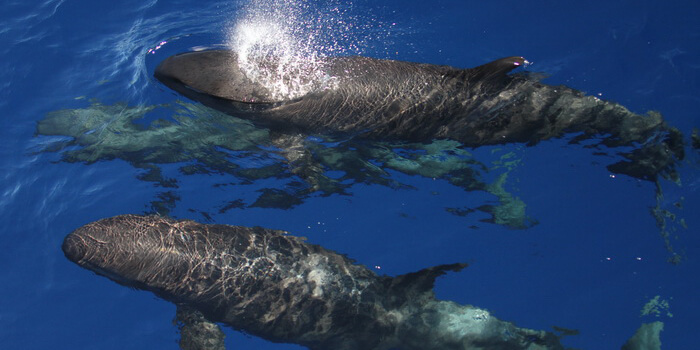
False killer whales, October 15, 2010. (Robin Baird, Cascadia Research, NMFS Permit # 731-1774)
Species Status
Abundance and Trends
Numerous aerial-survey, photo-identification, satellite-telemetry, and genetic studies have made the MHI insular population the world’s most thoroughly studied false killer whales. Based on photo-identification studies conducted through 2015, the MHI insular population was estimated to number between 150 and 200 whales (best estimate = 167), a level believed to be significantly fewer than were present in the late 1980s, when aerial surveys around the MHI occasionally documented groups exceeding 400 individuals. A recent analysis using data through 2022 provided an updated estimate of about 139 individuals, suggesting a continued downward trend in population size.
The pelagic population of false killer whales in Hawaiian waters is estimated to consist of approximately 5,500 individuals, with around 2,000 of those within the Hawaiian Islands EEZ. The large pelagic range of this population along with limited large-scale surveys make it difficult to assess trends in abundance for this population. The Northwestern Hawaiian Islands population is smaller and less studied, with an estimated abundance of around 400 individuals.
Distribution
False killer whales are highly social animals that form social clusters of related individuals that travel and forage together. Within pods, individuals may spread out over many miles when hunting, while smaller sub-groups spread apart and merge over periods of hours to days. The MHI insular population consists of four social clusters that occupy waters mostly within about 45 nautical miles of shore, although some individual members have been tracked as far as 71 nautical miles away from the islands. The Hawaiian pelagic population is a transboundary stock found up to hundreds of miles from the archipelago, with groups occasionally approaching as close as roughly seven nautical miles of the MHI. The Northwestern Hawaiian Islands insular population lives within just under 60 nautical miles of the chain’s small islets and banks from Gardner Pinnacles (midway along the chain) to Kauaʻi, with occasional excursions to the west side of Oʻahu in the MHI.
What the Commission Is Doing
The Commission has been an active member of the False Killer Whale Take Reduction Team (FKWTRT) since its inception in 2010. This multi-stakeholder team makes recommendations to the National Marine Fisheries Service (NMFS) on the development and refinement of the False Killer Whale Take Reduction Plan (FKWTRP).
In 2019, the Commission held its annual meeting in Hawaii, and dedicated one session to understanding the current status of interactions between pelagic false killer whales and the deep-set longline fishery, and between insular false killer whales and State managed hook-and-line fisheries (see session summaries).
In December 2020, the Commission commented on NMFS’s proposed Recovery Implementation Strategy for the MHI insular population. The Commission recommended that the Strategy address the relative urgency of different measures, identify necessary resources and collaborations, and prioritize the monitoring of state commercial and recreational fisheries with the potential to interact with MHI insular false killer whale. The final Recovery Plan and Implementation Strategy were published in November 2021.
Commission Reports and Publications
See the false killer whale sections in chapters on Species of Special Concern in past Marine Mammal Commission Annual Reports to Congress.
Commission Letters
| Letter Date | Letter Description |
|---|---|
| August 16, 2024 | Overdue amendment to the False Killer Whale Take Reduction Plan |
| December 18, 2020 | |
| January 2, 2018 | Letter to NMFS on a proposed critical habitat designation for MHI Insular false killer whales |
| July 10, 2014 | |
| October 1, 2012 | Letter to NMFS on a proposed rule to list MHI Insular false killer whales as endangered |
| February 17, 2010 | Letter to NMFS on the formation and meeting of the False Killer Whale Take Reduction Team |
| February 4, 2010 |
Learn More
Threats
The most significant threat to false killer whales in Hawaiʻi is interactions with fishing gear that lead to serious injury or death. False killer whales are attracted to longline fishing vessels, where they take (depredate) bait and hooked fish, such as mahi-mahi and yellowfin tuna. Consequently, they are sometimes caught on hooks or entangled in fishing lines. Such interactions with Hawaiʻi-based longline fisheries have become a significant conservation issue for false killer whales within Hawaiian waters and on the high seas (in other words, within and beyond the U.S. Exclusive Economic Zone (EEZ) – shore to 200 nautical miles offshore).
The majority of false killer whale bycatch in Hawaiʻi-based longline fisheries comes from the pelagic population, as the fishery operates outside of nearshore areas where the MHI population is commonly found. The high bycatch rates, both within and beyond the U.S. EEZ have been deemed unsustainable for the pelagic population, with concerns heightened by potential underreporting in U.S. fisheries and a lack of observer coverage on foreign vessels.
MHI insular false killer whales are also vulnerable to interactions with a variety of commercial and recreational fisheries in their nearshore habitat. Few deaths or serious injuries resulting from fisheries interactions have been documented in this population, but accurate estimates of the number of fisheries interactions are not available because the inshore fisheries are not monitored. However, recent analyses of fishery-related wounds or scars along the mouth-line or on the dorsal fin suggest that the frequency of fishery interactions in the MHI insular population occurs at an even higher rate than experienced by the pelagic population.
The Northwestern Hawaiian Islands false killer whale population often resides within the Papahānaumokuākea Marine National Monument, where restricted fishing activity has likely limited recent interactions with fisheries since the monument’s establishment.
Current Conservation Efforts
Hawaiian Pelagic False Killer Whale Population
The FKWTRT continues to identify and implement mitigation measures to reduce mortality and serious injury of the pelagic population in Hawaiʻi-based longline fisheries. Under the False Killer Whale Take Reduction Plan (FKWTRP), longline vessels are required to use weak circle hooks, strong branch lines, and specific hooking and release techniques when a false killer whale is caught. This gear configuration is intended to allow target species such as tuna and swordfish to be retained while enabling larger, stronger false killer whales to straighten the hook and escape.
However, the effectiveness of these measures has been mixed. Some whales successfully escape by straightening the hook, while others shed the hook only partially or remain entangled with embedded gear or trailing line, increasing the risk of serious injury. Observer data show inconsistent compliance with required handling techniques, such as maintaining steady tension until the hook straightens, on the roughly 20% of trips that are observed, with compliance likely lower on unobserved trips. The FKWTRT continues working to address these issues, including evaluating the use of stronger branch lines, improving understanding of what happens when whales are hooked, and refining release techniques used by longline crews. In addition, the FKWTRT is considering the use of electronic monitoring to increase the proportion of the fleet that is monitored.
The FKWTRP also includes a contingency measure that closes the Southern Exclusion Zone (SEZ), an area south of the main Hawaiian Islands, when a specified threshold of false killer whale mortalities or serious injuries within the U.S. Exclusive Economic Zone (EEZ) is reached. This threshold was first exceeded in 2018, when four whales were seriously injured or killed within the EEZ, triggering the closure of the SEZ from July 24 through December 31. In January 2019, another mortality and serious injury occurred within the EEZ, again closing the SEZ. Under the FKWTRP, the SEZ may reopen only after specific criteria are met, such as two years without additional mortality or serious injury, or when the estimated mortality rate falls below the population’s potential biological removal (PBR) level. In 2020, a larger population estimate was published, and NMFS reopened the SEZ after the mortality rate fell below the new PBR (which is based on population size). This also led to an increase in the threshold for closing the SEZ, from two to four mortalities and serious injuries.
In 2021, three mortalities or serious injuries occurred within the EEZ between mid-January and mid-April, followed by a fourth interaction in November. However, the determination that the November interaction resulted in a serious injury was not made until after the end of the calendar year. Because the SEZ closure is based on the number of confirmed mortalities and serious injuries within the calendar year, NMFS did not close the SEZ, revealing a timing-related gap in the closure policy. To address this issue, NMFS published a new SEZ trigger value in February 2024. The revised rule established a threshold of three observed mortalities or serious injuries within the U.S. EEZ for SEZ closure, replacing the previous four-interaction trigger. This rulemaking also clarified the criteria for reopening the SEZ and aligned the closure mechanism more closely with updated abundance estimates, PBR values, and management objectives.
In late 2022 and early 2023, the FKWTRT met to recommend new management/mitigation measures that would finally to reduce mortality and serious injury to levels less than the population’s PBR. However, the team could not reach consensus, which left NMFS with the responsibility for amending the FKWTRP using the ideas generated by the team and the recommendations from factions within the team. Proposed mitigation measures included reducing the amount of fishing taking place (effort reductions) and further modifications to the gear and fishing practices. NMFS is expected to publish proposed amendments to the FKWTRP in the next year.
Main Hawaiian Island Insular False Killer Whale Population
After designating the MHI insular population as endangered under the ESA in 2012, NMFS announced its intention to prepare a recovery plan to guide future research and management-recovery activities. In October 2020, NMFS released a draft recovery plan and implementation strategy for public review and comment. The Commission submitted comments in December 2020, and NMFS published the final recovery and implementation plans in November 2021.
In November 2017, NMFS published a proposal for designating critical habitat under the ESA. The Commission recommended that NMFS “undertake or support research needed to refine that designation by determining if there are specific areas that are essential to enabling the population to sustain itself in a healthy and productive state, to recover to the point where listing under the ESA is no longer warranted and, ultimately to reach its carrying capacity level.” The final Critical Habitat designation, which was announced in July 2018, excluded three additional areas from the designation due to national security concerns, and an assessment that the areas are used only infrequently by false killer whales.